Translation and Meaning of: 象徴 - shouchou
The Japanese word 象徴[しょうちょう] is a term rich in meaning and deeply rooted in the culture and language of Japan. In this article, we will explore its meaning, origin, and everyday use, as well as understand how it relates to cultural and social aspects of the country. Whether you are studying Japanese or just curious about this expression, this guide will help you comprehend it clearly and practically.
Meaning and Translation of 象徴[しょうちょう]
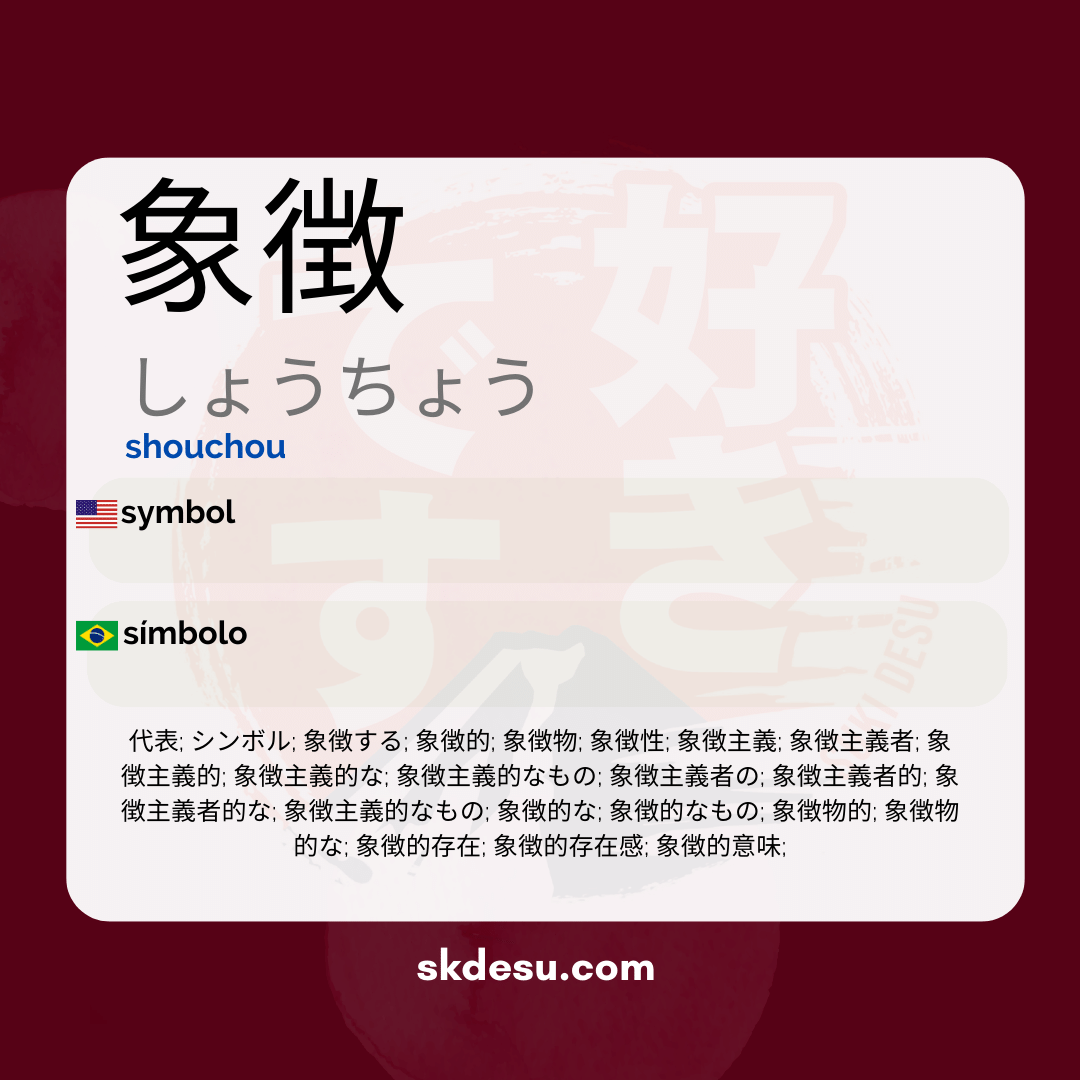
象徴[しょうちょう] can be translated as "symbol" or "emblem," but its meaning goes beyond a simple visual representation. The word carries the idea of something that encapsulates a larger concept, serving as a concrete manifestation of values, ideas, or identities. For example, Mount Fuji is not just a mountain—it is a 象徴 of Japanese culture.
In formal contexts, such as political speeches or academic texts, しょうちょう is often used to describe elements that summarize complex ideas. In everyday life, it can appear in discussions about art, history, or even in news, always with this notion of symbolic representation.
Origin and Use of Kanjis
The writing of 象徴 combines two kanjis: 象 (elephant, shape, appearance) and 徴 (sign, evidence). Together, they convey the idea of "visible representation of something abstract." The first kanji, 象, also appears in words like 象形文字 (pictographic characters), reinforcing its connection to representation. On the other hand, 徴 is used in terms like 特徴 (characteristic), indicating distinctive traits.
It is worth noting that, although 象 alone means "elephant," in this context it takes on a broader sense of "form" or "image." This duality is common in kanjis and shows how the composition of ideograms can add layers of meaning to Japanese words.
Cultural Use and Practical Examples
In Japan, 象徴 is a word often associated with cultural and historical elements. The sakura (cherry blossom), for example, is a 象徴 of ephemeral beauty—an important concept in Japanese philosophy. Similarly, the national flag, with its red circle, serves as a 象徴 of the country's identity.
In media such as animes and movies, it is common to see this word being used to describe objects or characters that carry a deeper meaning. A lightsaber in Star Wars, for example, could be called 象徴 in Japanese, as it represents values such as honor and courage within the narrative.
Vocabulary
Expand your vocabulary with related words:
Synonyms and similar words
- 代表 (Daihyou) - Representation
- シンボル (Shinboru) - symbol
- 象徴する (Shouchou suru) - Symbolize
- 象徴的 (Shouchou-teki) - symbolic
- 象徴物 (Shouchou-butsu) - Symbolic object
- 象徴性 (Shouchou-sei) - Symbolic character
- 象徴主義 (Shouchou shugi) - Symbolism
- 象徴主義者 (Shouchou shugi-sha) - Symbolist
- 象徴主義的 (Shouchou shugi-teki) - Regarding symbolism
- 象徴的存在 (Shouchou-teki sonzai) - Symbolic existence
- 象徴的存在感 (Shouchou-teki sonzaikan) - Symbolic weight
- 象徴的意味 (Shouchou-teki imi) - Symbolic meaning
Related words
Romaji: shouchou
Kana: しょうちょう
Type: noun
L: jlpt-n1
Translation / Meaning: symbol
Meaning in English: symbol
Definition: Something that represents something specific.
Quick Access
- Vocabulary
- Writing
- Sentences
How to Write in Japanese - (象徴) shouchou
See below a step-by-step guide on how to write the word by hand in Japanese. (象徴) shouchou:
Example Sentences - (象徴) shouchou
See below some example sentences:
Chou wa utsukushii haru no shouchou desu
Butterflies are a beautiful symbol of spring.
Butterflies are a beautiful symbol of spring.
- 蝶 (ちょう) - butterfly
- は - Topic particle
- 美しい (うつくしい) - Beautiful, nice
- 春 (はる) - spring
- の - Possession particle
- 象徴 (しょうちょう) - symbol, emblem
- です - polite way of being
Amelika wa jiyū to minshu shugi no shōchō desu
America is a symbol of freedom and democracy.
The United States is a symbol of freedom and democracy.
- アメリカ - America
- は - Topic particle
- 自由 - freedom
- と - I'm sorry, but I need a text or string to translate from Portuguese to English. Please provide the content you'd like me to work on.
- 民主主義 - democracy
- の - Possession particle
- 象徴 - symbol
- です - Verb to be/estar in the present
Tennou wa Nihon no shouchouteki sonzai desu
The emperor is a symbol of Japan.
- 天皇 - Emperor of Japan
- は - Topic particle
- 日本 - Japan
- の - Possession particle
- 象徴的 - symbolic
- 存在 - existence
- です - Verb to be/estar in the present
Maneki neko wa shōbai hanjō no shōchō desu
The lucky cat is a symbol of prosperity in business.
The waving cat is a symbol of business prosperity.
- 招き猫 - lucky cat
- は - Topic particle
- 商売繁盛 - prosperity in business
- の - Possession particle
- 象徴 - symbol
- です - Verb to be/estar in the present
Shinden wa kodai no shinkō no shōchō desu
The temple is a symbol of the ancient faith.
The temple is a symbol of ancient religion.
- 神殿 - temple
- は - Topic particle
- 古代 - old
- の - Possessive particle
- 信仰 - Faith, belief
- の - Possessive particle
- 象徴 - symbol
- です - Verb to be
Shouchou suru mono wa nan desu ka?
What is the symbol?
- 象徴する - verb that means "symbolize"
- もの - noun that means "thing"
- は - particle that indicates the topic of the sentence
- 何 - interrogative pronoun that means "what"
- ですか - particle that indicates a formal question
Other Words of this Type: noun
See other words from our dictionary that are also: noun