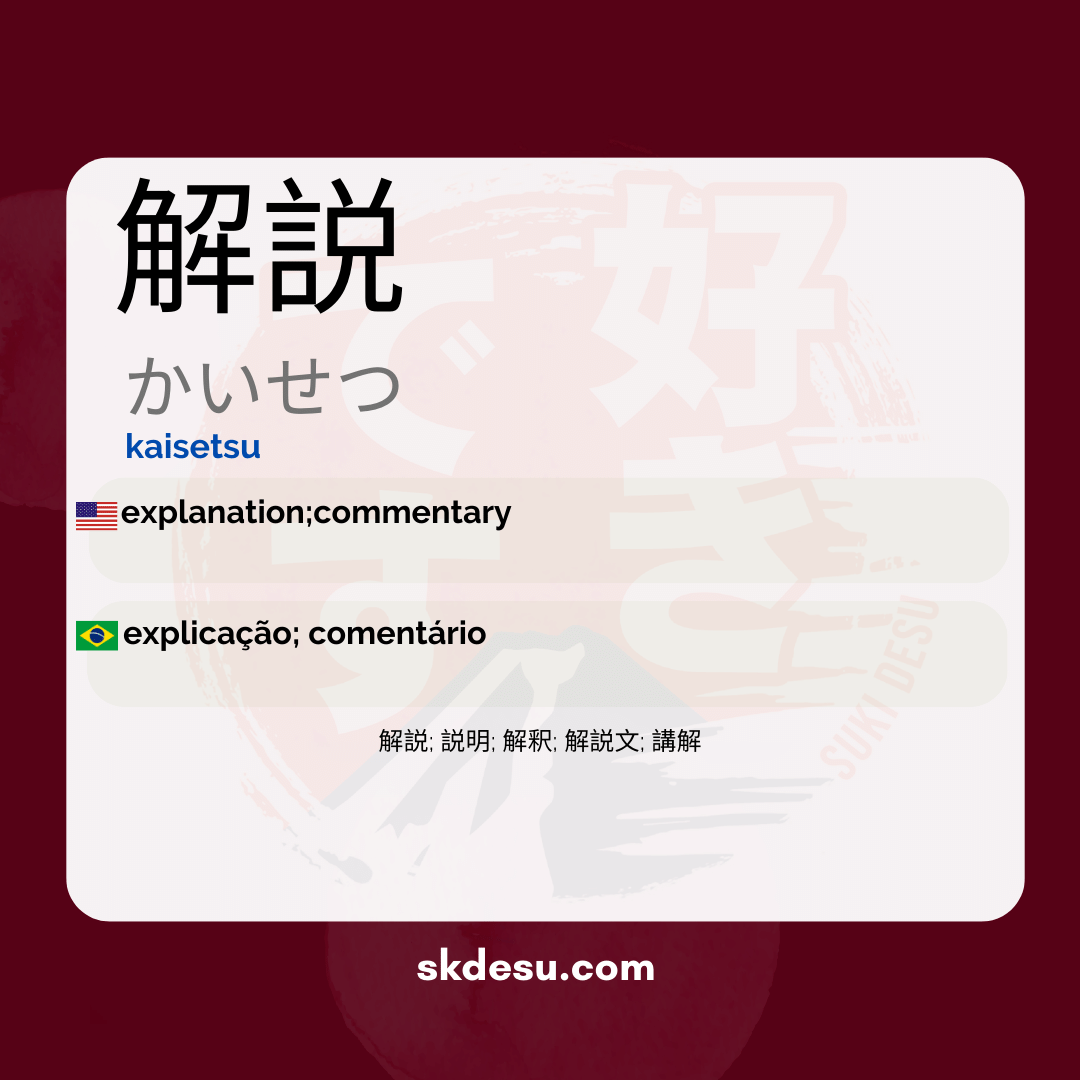
Translation and Meaning of: 解説 - kaisetsu
The Japanese word 解説 (かいせつ, kaisetsu) is a common term in everyday life in Japan, especially in educational, media, and even more formal conversation contexts. If you have ever watched a documentary, read a manual, or participated in a lecture in Japanese, it is highly likely you have encountered it. But what exactly does 解説 mean, how is it used, and why is it so relevant? In this article, we will explore everything from the basic meaning to cultural details that make this word an essential part of the Japanese vocabulary.
Meaning and translation of 解説
解説 (かいせつ) can be translated into English as "explanation," "commentary," or "detailed analysis." Unlike a simple definition, the term carries the idea of a structured clarification, often accompanied by examples or contextualization. For example, in TV programs, a narrator may provide a 解説 about the rules of a game or the details of a historical event.
It is worth noting that while "explanation" is a direct translation, 解説 tends to be more formal and comprehensive. While 説明 (せつめい, setsumei) is used for everyday explanations, 解説 appears in situations that require depth, such as classes, technical articles, or critical analyses.
Origin and composition of the kanji 解説
The word 解説 is formed by two kanjis: 解 (kai), which means "to unravel" or "to solve," and 説 (setsu), which carries the sense of "to explain" or "theory." Together, they emphasize the notion of an explanation that dismantles a complex subject, making it accessible. This combination is not random—it reflects the importance that Japanese culture places on the act of clarifying concepts methodically.
Interestingly, the kanji 解 also appears in words like 解決 (kaiketsu, "problem solving") and 理解 (rikai, "understanding"), showing its connection to ideas of clarity and comprehension. Meanwhile, 説 is found in terms like 説明 (setsumei, "explanation") and 小説 (shousetsu, "novel"), indicating its relationship with narratives and discourses.
Cultural usage and frequency of 解説 in Japan
In Japan, 解説 is widely used in academic and media environments. Teachers provide 解説 of classical texts, journalists offer 解説 on complex news, and even YouTubers create 解説 videos for popular topics, such as animes or technology. This versatility makes the word one of the most recurring in educational materials and TV programs.
An interesting cultural aspect is that the Japanese value detailed and well-founded explanations—something that 解説 perfectly represents. It is not uncommon to find entire books dedicated to the 解説 of literary works or historical events, highlighting how the term is rooted in the pursuit of clear and organized knowledge.
Tips for memorizing 解説
An effective way to solidify 解説 is to associate it with situations where deep explanations are necessary. For example, think of a documentary about astronomy: the narrator doesn't just say "this is a star," but provides a 解説 about its life cycle, composition, and importance. Creating this type of mental connection helps to internalize the term.
Another tip is to practice with authentic materials, such as Japanese news or educational channels on YouTube. By hearing 解説 being used naturally, you reinforce both the meaning and the pronunciation (かいせつ). Repeating it out loud can also be helpful, as the sound is simple and distinctive.
Vocabulary
Expand your vocabulary with related words:
Synonyms and similar words
- 解説 (kaisetsu) - Detailed explanation or interpretation of a theme.
- 説明 (setsumei) - Description or clarification about a subject.
- 解釈 (kaishaku) - Interpretation of texts or meanings.
- 解説文 (kaisetsubun) - Explanatory text that provides a deeper understanding.
- 講解 (koukai) - Explanation or comment made during a lecture or class.
Related words
Romaji: kaisetsu
Kana: かいせつ
Type: noun
L: jlpt-n2
Translation / Meaning: explanation; comment
Meaning in English: explanation;commentary
Definition: Explain the content and meaning of words and things.
Quick Access
- Vocabulary
- Writing
- Sentences
How to Write in Japanese - (解説) kaisetsu
See below a step-by-step guide on how to write the word by hand in Japanese. (解説) kaisetsu:
Example Sentences - (解説) kaisetsu
See below some example sentences:
Kono hon wa totemo wakariyasui kaisetsu ga kakarete imasu
This book has a very easy explanation to understand.
- この - demonstrative pronoun that means "this"
- 本 - noun meaning "book"
- は - topic particle that indicates that the book is the subject of the sentence
- とても - adverb meaning "very"
- わかりやすい - adjective that means "easy to understand"
- 解説 - noun meaning "explanation"
- が - subject particle that indicates that the explanation is the subject of the sentence
- 書かれています - passive verb that means "was written"
Other Words of this Type: noun
See other words from our dictionary that are also: noun