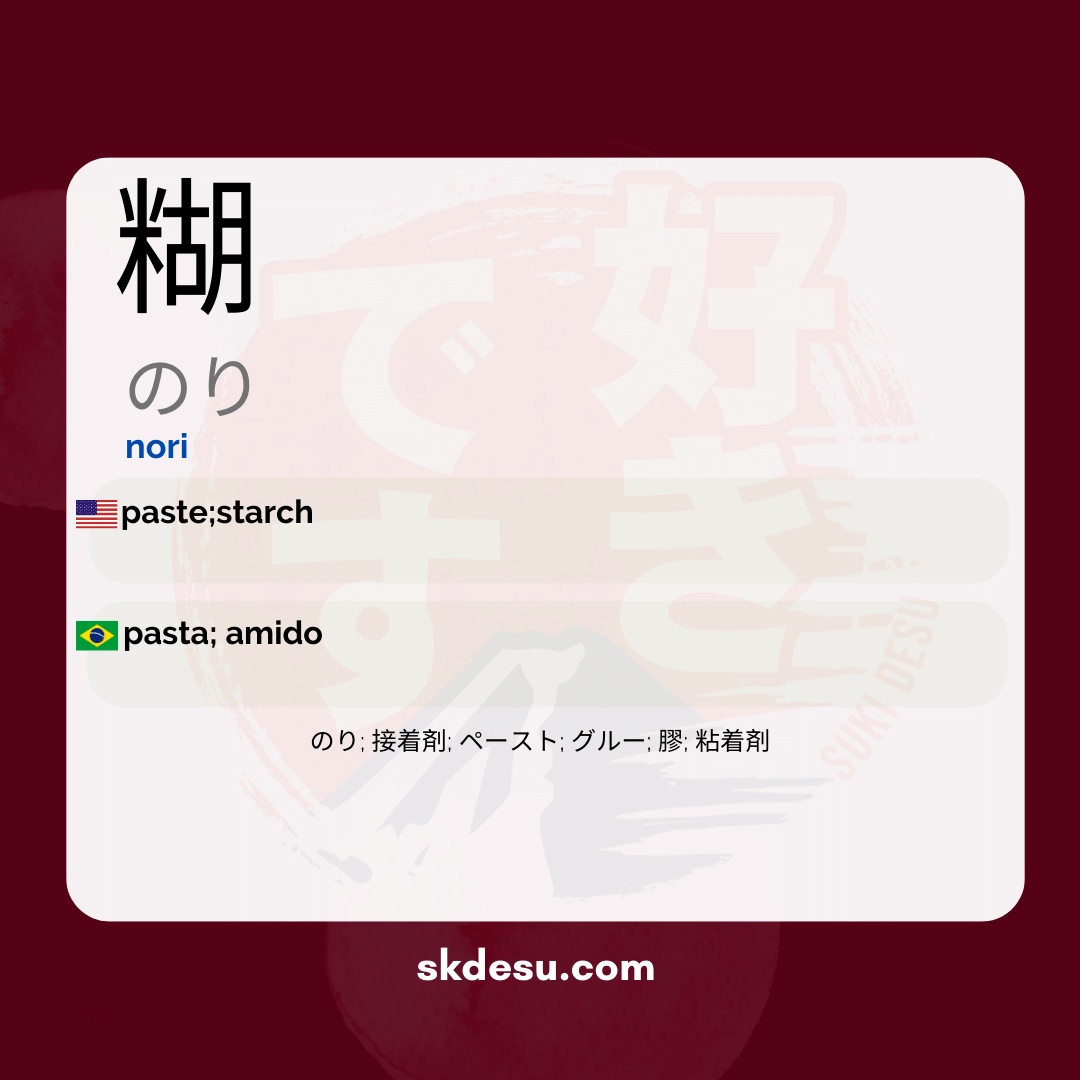
Translation and Meaning of: 糊 - nori
The Japanese word 糊[のり] may seem simple at first glance, but it carries interesting nuances for those learning the language. If you've ever wondered about its meaning, origin, or how to use it in everyday life, this article will clarify those questions. Here, we will explore everything from the writing of the kanji to the cultural context in which the word appears, all based on reliable sources such as the Suki Nihongo dictionary.
Meaning and usage of 糊 [のり]
糊[のり] is commonly translated as "glue" or "adhesive." In Japan, it is used to refer to substances that bond surfaces, from school glue to traditional adhesives made from starch. The term is frequently used in everyday life, especially in domestic and school contexts.
One curiosity is that 糊 can also appear in expressions like 糊付け [のりづけ], which means "gluing." This type of use reinforces the idea of unity, whether literal or figurative. Although it's not a complex word, understanding its usage helps to expand practical vocabulary.
Origin and writing of kanji
The kanji 糊 is composed of the radical 米 (rice) and the component 胡, which suggests a relation to ingredients used in traditional glues. Historically, many glues in Japan were made from rice starch, which explains the presence of this radical. This connection between writing and meaning aids in memorization.
It is worth noting that 糊 is not one of the most frequent kanji, but it appears in teaching materials and manuals. Its reading のり is kun'yomi (Japanese reading), which is useful for those studying the different reading systems of the ideograms.
Tips for memorizing and using 糊[のり]
An effective way to reinforce the word is to associate it with everyday situations, such as manual work or repairs at home. Phrases like "この糊で紙を貼ります" (I will paste the paper with this glue) help internalize the term in a real context. Writing down practical examples in Anki or on flashcards can also be useful.
Another tip is to observe the kanji 糊 on packaging of adhesive products or in stationery stores. This type of visual exposure reinforces learning. Remember that, although simple, words like this are essential for basic communication in Japanese.
Vocabulary
Expand your vocabulary with related words:
Synonyms and similar words
- のり (nori) - Edible cola, commonly used in cooking, such as for sushi.
- 接着剤 (secchaku-zai) - Adhesive in general, used to bond different materials.
- ペースト (pēsu) - Paste-shaped adhesive, used to stick paper and other lightweight materials.
- グルー (gurū) - The term in English for "cola," typically referring to a strong adhesive, is "glue."
- 膠 (nikawa) - Traditional glue made from animal collagen, used in arts and crafts.
- 粘着剤 (nenchaku-zai) - Adhesive in general, which keeps a surface stuck.
Romaji: nori
Kana: のり
Type: noun
L: jlpt-n2
Translation / Meaning: folder; starch
Meaning in English: paste;starch
Definition: Adhesive substance used to glue paper, fabric, etc.
Quick Access
- Vocabulary
- Writing
- Sentences
How to Write in Japanese - (糊) nori
See below a step-by-step guide on how to write the word by hand in Japanese. (糊) nori:
Example Sentences - (糊) nori
See below some example sentences:
Nenhum resultado encontrado.
Other Words of this Type: noun
See other words from our dictionary that are also: noun