Translation and Meaning of: 溺れる - oboreru
The Japanese word 溺れる (おぼれる) is a verb that carries an intense and specific meaning. If you are studying Japanese or are simply interested in the language, understanding its use, origin, and cultural context can be quite helpful. In this article, we will explore what this word represents, how it is written in kanji, and how the Japanese use it in daily life. Additionally, we will see practical tips for memorizing it and interesting facts that make learning it more engaging.
Meaning and usage of 溺れる
Oboreru (おぼれる) means "to drown" or "to be submerged," both literally and figuratively. In the literal sense, it refers to the act of drowning in water, such as in accidents or dangerous situations. In the figurative sense, it can express the idea of being "drowned" in problems, emotions, or even in vices, such as work or love.
The use of this word in everyday Japanese is not extremely frequent, but it appears in contexts where there is a strong emotional charge. For example, in news about maritime accidents or in expressions that describe someone completely absorbed in a situation. Its kanji, 溺, is composed of the water radical (氵) combined with other elements that reinforce the idea of submersion.
Origin and writing of the kanji 溺
The etymology of 溺れる traces back to the kanji 溺, which appears in classical Chinese texts before being incorporated into Japanese. The water radical (氵) indicates its relation to liquids, while the remaining part of the character suggests an action of sinking or being swept away by the current. This visual combination reinforces the meaning of the word, making its mental association easier.
It is worth noting that, although kanji is complex, its reading in hiragana (おぼれる) is more accessible for beginners. A useful tip for memorizing it is to think of the image of someone being "pulled" by the water, represented by the radical 氵. This type of visual association can help in learning, especially for those who are starting to study kanji.
Trivia and memorization tips
An interesting fact about 溺れる is that it is rarely used in a light or casual way. Unlike words like 泳ぐ (to swim), which can appear in everyday conversations, 溺れる typically carries a more serious or dramatic tone. This makes its use more common in news, literature, or discussions about real dangers.
To memorize this word, an effective strategy is to associate it with specific situations, such as movie scenes or news involving drowning. Another tip is to practice writing it in kanji several times, focusing on the water radical to solidify its structure. When learning words with intense meanings like this one, context is always a powerful ally.
Vocabulary
Expand your vocabulary with related words:
Verb conjugation of 溺れる
- 溺れる Dictionary form
- 溺れます Polite way
- 溺れた Simple past
- 溺れています Present continuous
- 溺れれば Conditional
Synonyms and similar words
- 溺れこむ (oborekō) - to drown, to be pulled into the water
- 溺れ死ぬ (obore shinu) - drowning to death, death by drowning
- 溺れる (oboreru) - to drown, to have difficulties in water
- 沈む (shizumu) - sink, submerge (in the context of something that cannot float)
- 沈没する (chinbutsu suru) - sink (a ship or vessel)
- 沈んでいく (shizundeiku) - gradually sink, slowly submerge
- 沈んでい (shizundei) - sinking, the act of sinking (generally in a progressive context)
Related words
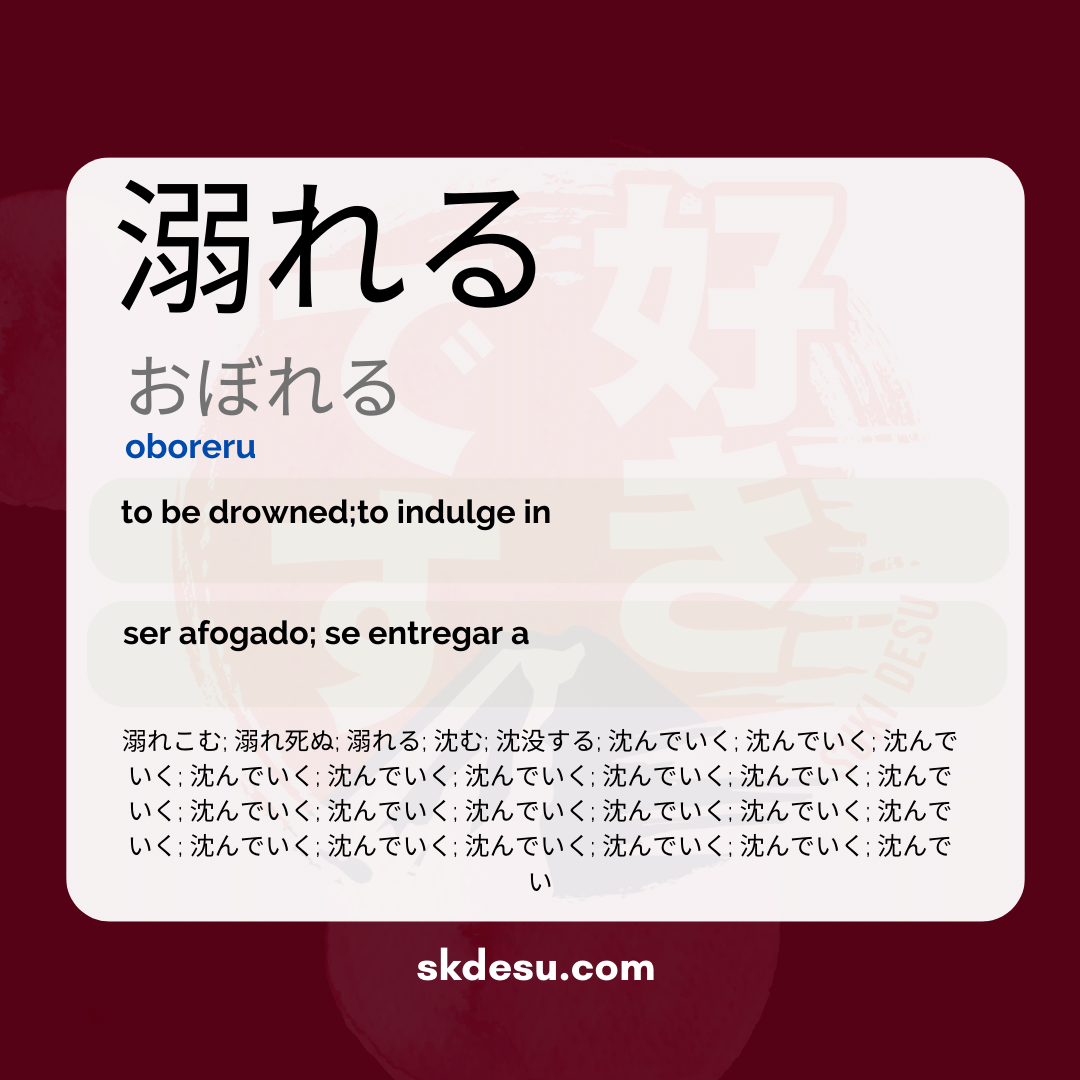
Romaji: oboreru
Kana: おぼれる
Type: verb
L: jlpt-n3
Translation / Meaning: be drowned; surrender
Meaning in English: to be drowned;to indulge in
Definition: Being submerged in water and unable to breathe.
Quick Access
- Vocabulary
- Writing
- Sentences
How to Write in Japanese - (溺れる) oboreru
See below a step-by-step guide on how to write the word by hand in Japanese. (溺れる) oboreru:
Example Sentences - (溺れる) oboreru
See below some example sentences:
Watashi wa oboreru koto o osoreteimasu
I'm afraid of drowning.
I'm afraid of drowning.
- 私 (watashi) - Japanese personal pronoun that means "I"
- は (wa) - Japanese particle that marks the topic of the sentence
- 溺れる (oboreru) - Japanese verb meaning "to drown"
- こと (koto) - A palavra japonesa que significa "coisa" é "もの" (mono).
- を (wo) - Japanese particle that marks the direct object of the sentence
- 恐れています (osoreteimasu) - Japanese verb meaning "to be afraid"
Other Words of this Type: verb
See other words from our dictionary that are also: verb