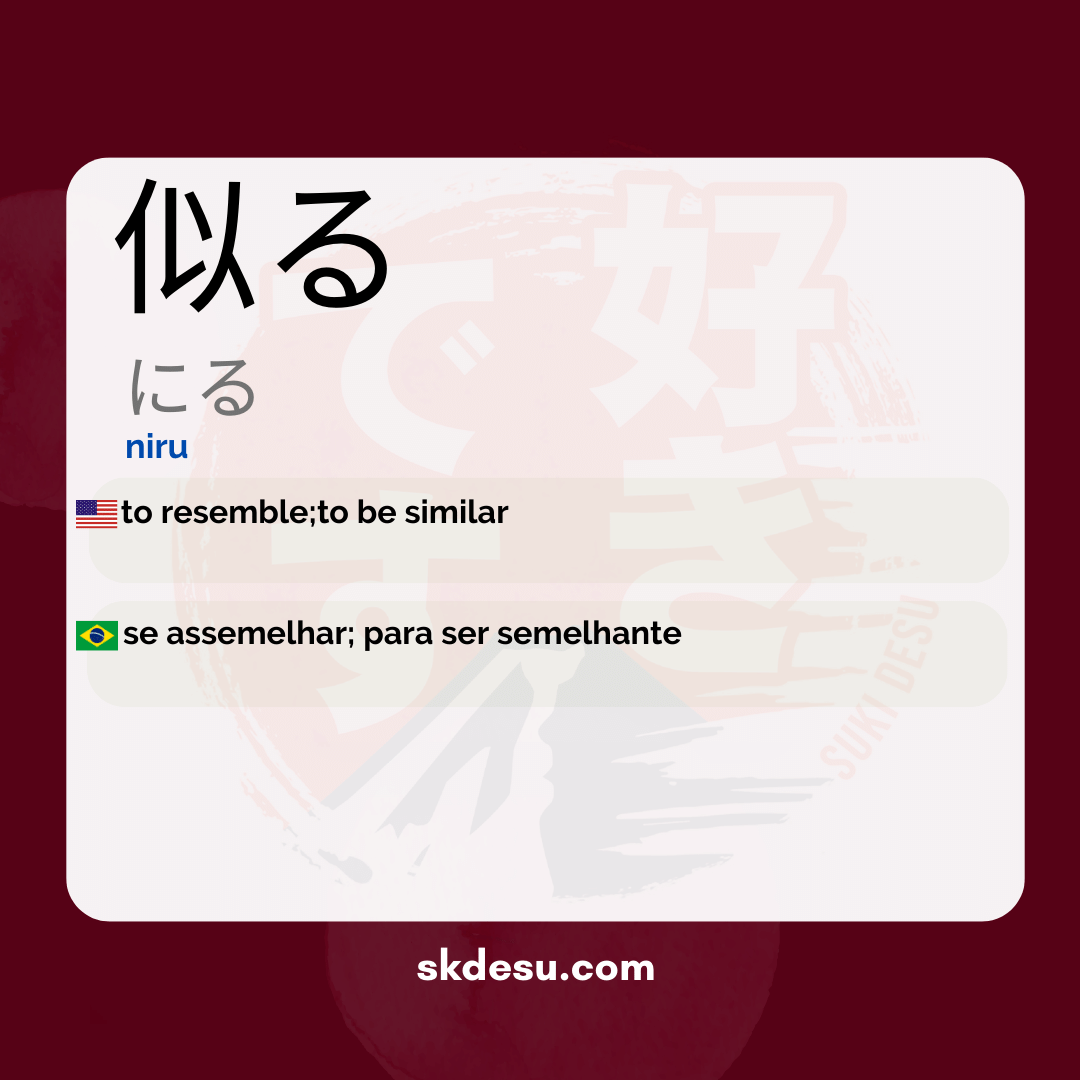
Translation and Meaning of: 似る - niru
The Japanese word 似る (にる, niru) is a common verb that carries interesting meanings and practical applications in everyday life. If you are learning Japanese or simply curious about the language, understanding how this word works can be very useful. In this article, we will explore its meaning, origin, usage in sentences, and even some tips to memorize it efficiently. All this is based on reliable sources and verified information, so you can learn in the right way.
In addition to describing what 似る means, let's see how the Japanese use it in different contexts, from informal conversations to more specific situations. If you've ever wondered how to say that something or someone "resembles" something else in Japanese, this word is essential. And if you want to deepen your studies, Suki Nihongo offers one of the best online dictionaries to consult terms like this.
Meaning and usage of 似る
似る is a verb that means "to resemble," "to be similar," or "to look like." It is used when we want to compare two things or people, indicating that there is a similarity between them. For example, if someone says that you resemble a relative, you can use this word to express that idea. It is a quite versatile term and appears frequently in everyday conversations.
An important characteristic of 似る is that it usually requires a particle to make the comparison. In many cases, the particles と (to) or に (ni) are used to indicate with whom or with what something resembles. For example, the sentence "この子はお母さんに似ている" (Kono ko wa okaasan ni nite iru) means "This child resembles the mother." Notice how the verb takes the form 似ている (nite iru) in the present continuous, which is the most common way to use it in daily life.
Origin and composition of the kanji 似
The kanji 似 is composed of two radicals: 亻 (person) and 以 (to use, based on). This combination suggests the idea of "comparison between people" or "similarity based on something." According to the Kangorin dictionary, this kanji was already used in ancient Chinese with a meaning similar to the current one, indicating that its usage in Japanese has maintained this essence throughout the centuries.
It is worth noting that 似る is a group 2 verb (ichidan), which means its conjugation follows a specific pattern. For example, its negative form is 似ない (ninai), and the past form is 似た (nita). Knowing this helps to use it correctly in different grammatical situations, especially if you are studying Japanese in a more structured way.
Tips for remembering and using 似る
An effective way to remember the meaning of 似る is to associate it with real-life situations. For example, think about how people often comment that children resemble their parents. Creating sentences like "妹は私に似ている" (My sister looks like me) can help anchor the verb in your memory. Another tip is to practice with flashcards or apps like Anki, inserting examples that make sense to you.
Additionally, it's useful to note that 似る is not used for identical objects, but rather for things that have traits in common. If something is exactly the same, other terms like 同じ (onaji) may be more appropriate. This nuance is important to avoid common mistakes among Japanese learners. With time and practice, using 似る will become natural in your conversations.
Vocabulary
Expand your vocabulary with related words:
Verb conjugation of 似る
- 似る - Present form
- 似ている - Present continuous form
- 似た - past form
- 似ていた - Past continuous form
- 似よう - Future form
- 似て - imperative form
Synonyms and similar words
- 似る (Niru) - To resemble, to be similar
- 似ている (Niteiru) - To be similar, to be alike (continuous form)
- 似せる (Niseru) - Make it seem, imitate
Romaji: niru
Kana: にる
Type: verb
L: jlpt-n4
Translation / Meaning: resemble; to be similar
Meaning in English: to resemble;to be similar
Definition: similar in appearance and properties to others.
Quick Access
- Vocabulary
- Writing
- Sentences
How to Write in Japanese - (似る) niru
See below a step-by-step guide on how to write the word by hand in Japanese. (似る) niru:
Example Sentences - (似る) niru
See below some example sentences:
Kanojo to watashi wa niru you ni mieru
She and I look similar.
- 彼女 - "Namorada" significa "彼女" (かのじ, kanojo) em japonês.
- と - a binding particle in Japanese, which can be translated as "and" or "with"
- 私 - signifies "I" in Japanese
- は - a particle in Japanese that indicates the topic of the sentence
- 似る - a Japanese verb meaning "to resemble"
- ように - a particle in Japanese that indicates a comparison or similarity
- 見える - a Japanese verb meaning "to look" or "to appear"
Other Words of this Type: verb
See other words from our dictionary that are also: verb